
(Disclaimer: Spoilers for season two of “Fallout” ahead)
The first season of Amazon’s “Fallout” adaptation, produced by Johnathan Nolan and Lisa Joy, premiered in early 2024 to immense positive reception. Its characters, expansion of the series’ lore, faithfulness to its style and humor, and telling a separate story within the beloved universe were widely praised by fans and newcomers to the franchise alike. Criticism was levied towards the show, however, for “resetting” Fallout’s world back to its post-apocalyptic state, where the franchise typically showed civilization redeveloping after the nuclear apocalypse. Regardless, the show raked in millions of viewers and was regarded as one of, if not the best, video game adaptation. A second season was quickly greenlit after the success of the first, and a third season was greenlit in May 2025, before the release of season two.
Season two of “Fallout” premiered on December 17, 2025 and ended Feb. 3, opting for weekly episodes instead of season one’s binge release.
Season two takes the main duo, Lucy and The Ghoul, to New Vegas, from what is arguably the most beloved entry in the franchise: “Fallout: New Vegas.” Maximus’ story continues in the Brotherhood of Steel, the wasteland’s tech-obsessed militaristic group-as the factions of the Brotherhood grow ever-zealous and closer to internal conflict. Vault-33, the underground nuclear vault, converges into two different stories focused on the mysteries of the Vault-Tec corporation and its higher-ups.
One of season one’s biggest strengths, the performances, is still fully present in season two. Ella Purnell (Lucy MacLean), Kyle MacLachlan (Hank MacLean), Aaron Moten (Maximus), and Walton Goggins (The Ghoul/Cooper Howard) give killer performances like before. Goggins is still the star performance in season two. He practically plays two different characters with pre-war Cooper and The Ghoul, and he gives it his all, despite the drastic differences (yet natural evolution) between the two. Other characters, like Norm Maclean (Moisés Arias) and Stephanie Harper (Annabel O’Hagan) get even more screentime in season two as they enter the show’s wider plot-both with excellent acting. O’Hagan especially shines in the later episodes as Steph’s story unfolds. Thaddeus, played by Johnny Pemberton, becomes a highlight in season two as well as he joins Maximus’ storyline. He’s given more screentime and becomes a great comedic relief character who still gets his serious moments when the show calls for it.
New stars joined season two’s cast as well-Ron Pearlman, the voice of the opening narration in the games; Macaulay Culkin, the iconic “Home Alone” star; Martha Kelly, Kumail Nanjiani, and more-with varying degrees of presence throughout the season.
Speaking of performances, the actor dynamics are the real killer in season two. Justin Theroux, filmmaker and actor joins season two’s cast as Robert House: main antagonist of “Fallout: New Vegas;” owner of the city, New Vegas; and business extraordinaire. He takes over the role from Rene Auberjonois, voice of Mr. House in “Fallout: New Vegas,” who died in 2019. Theroux gives an incredible performance which feels just in line for House, when he and Goggins interact-which is quite often-the two play off each other perfectly as their characters are practically opposites, the cold businessman versus the idealistic Cooper playing hero. Theroux isn’t the only member of the cast that Goggins is incredible with. It’s Frances Turner-who plays Cooper’s wife that also shines. Turner’s raw, emotional, guilt-ridden performance clashes excellently with Goggins as they both play off his attempted heroism-which makes him an all the more tragic character when he becomes the cold killer as The Ghoul, and Lucy becomes the naive hero. Kyle MacLachlan and Ella Purnell share an incredible dynamic in the latter episodes of the season as well, it’s a raw, emotional, very love-hate dynamic as Lucy’s familial love clashes with her need to bring her father to justice.
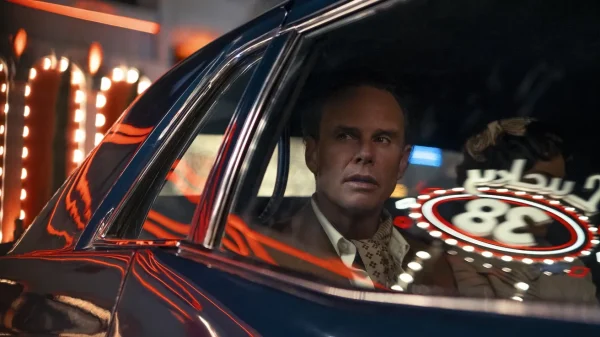
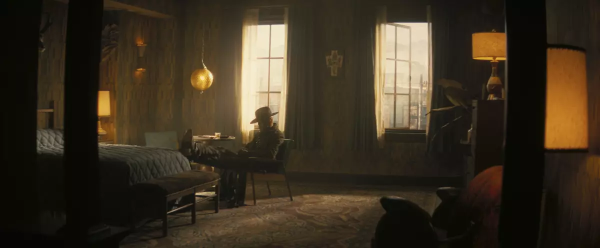
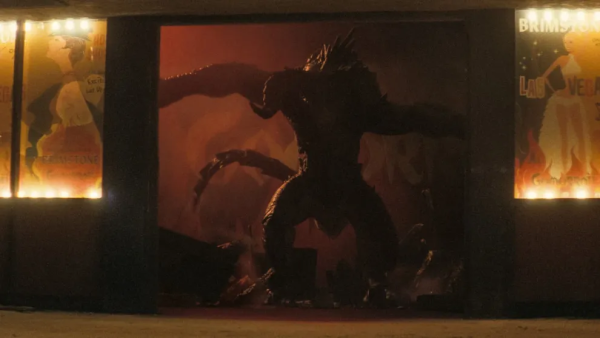
Beyond the characters, season two’s visuals are nothing short of impeccable. The lighting, set design, and cinematography all shine, especially in New Vegas. The season’s latter episodes, particularly “The Demon in the Snow,” “The Wrangler,” and “The Handoff” are especially strong as both pre- and post-apocalypse New Vegas shine on a technical level. They play a lot with great character-driven cinematography and lighting, but also some intense action and horror elements with the introduction of a certain iconic enemy from the franchise. Even dialogue scenes, especially the ones between Cooper and Mr. House, are shot and lit excellently with visual work that emphasizes the importance of their interaction, the power Mr. House holds in New Vegas and the business world, and-but more importantly-what power he doesn’t hold. The second season also continues in the first season’s footsteps, making use of lots of practical effects and physical sets, especially in New Vegas.
The feel of “Fallout” is still perfectly captured as well. Not just in the wider narrative or the various references to characters, events and enemies from the games, but the general feel-the over the top gore and action, alongside the serious, thematic political thriller story and commentary; the deadpan humor mixed with heartfelt moments-is all quintessentially Fallout, despite how often those things conflict in stories.
“Fallout” season two isn’t perfect, however. The second season struggles a lot with pacing. The eight-episode format hurts it a lot as it struggles to juggle all the plots it introduces. The season starts out quite slowly, which would be fine if there were more episodes and the significant events didn’t all occur in the season’s latter half. It’s not the e
nd of the world for the show; it’s still incredibly strong, but it’s quite noticeable, especially due to the weekly release schedule that season two opted for. None of the plots-even the side plots-that the show brings are bad, they’re far from it, but with only eight episodes the show doesn’t have time to properly develop them all. It goes to show the importance of longer seasons. Even just 2-4 more episodes would substantially benefit future seasons.
Season two of “Fallout” may not be as strong overall as its first season. It struggles a lot in pacing and the main plots are definitely more referential to the wider franchise than the first season (though the show does a good job explaining the basics of the major players and factions of the franchise), but what’s here is still quite impressive. The visuals, character work, and action are all even better than season one’s already stellar work. Fallout still sits as arguably the best game adaptation-a strong 8.5-9/10.